Month: April 2009

  • Turkish Military Against Armenia Border Opening

    Turkish Military Against Armenia Border Opening

    30.04.2009

    Emil Danielyan

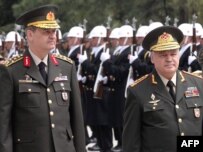
    Turkey’s powerful military has spoken out against normalizing relations with Armenia before a resolution of the Nagorno-Karabakh conflict, raising more questions about a U.S.-brokered agreement announced by Ankara and Yerevan last week.

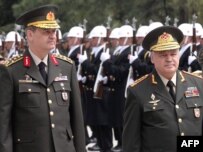
    General Ilker Basbug, chief of the Turkish General Staff, was reported to endorse late Wednesday Prime Minister Recep Tayyip Erdogan’s statements linking the reopening of the Turkish-Armenian border with the liberation of Armenian-occupied territories of Azerbaijan.

    “The prime minister has clearly said the border opening will take place at the time when Armenian troops are withdrawn,” Basbug told a news conference, according to Turkish media. “We completely agree with this.”

    Erdogan repeatedly made that linkage earlier this month, pouring cold water on hopes that the fence-mending negotiations between Turkey and Armenia will yield tangible results soon. Still, the Turkish and Armenian foreign ministries announced in a joint statement on April 22 that the two governments have agreed on a “roadmap” on normalizing bilateral ties.

    It remained unclear, however, when they plan to establish diplomatic relations and reopen the border. Neither government has officially disclosed the framework yet.

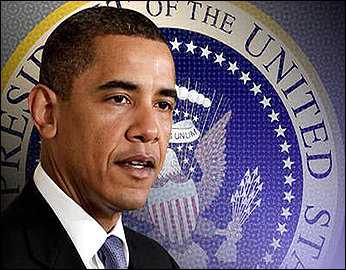
    Reports in the Turkish press have said that the United States was closely involved in the drawing up of the Turkish-Armenian statement. According to “Hurriyet Daily News,” Erdogan agreed to sign it only after Washington threatened to recognize the 1915 mass killings of Armenians in the Ottoman Empire as genocide. U.S. President Barack Obama refrained from using the word in his April 24 statement that commemorated the 94th anniversary of the massacres.

    Meanwhile, diplomatic sources in Yerevan said on Thursday that Foreign Minister Eduard Nalbandian will fly to Washington this weekend for talks with U.S. Secretary of State Hillary Clinton. Turkish-Armenian relations will be high on their agenda.

    Clinton and Nalbandian already discussed the issue over the phone on Monday. According to the Armenian Foreign Ministry, Clinton described the “roadmap” agreement as “historic.”

    https://www.azatutyun.am/a/1619312.html

  • US Congresswoman: “1915 events are not genocide”

    US Congresswoman: “1915 events are not genocide”

    Washington – APA. Member of US House of Representative from Ohio Jean Schmidt will make an official complaint against the Armenian, who libeled her for non-recognition of false “Armenian genocide”. Schmidt decided to complain to the Ohio election committee against her former rival in November 4 2008 elections David Grigorian, APA reports quoting Milliyet newspaper. Grigorian accused Schmidt in receiving of blood money from Turks to deny the “genocide”. Schmidt said it was not correct to call the 1915 events as genocide. “I never voted for the “Armenian genocide” resolutions at the Congress. I always consider that it is not a problem of the Congress. I support the idea of establishing the independent international commission of the experts to resolve this issue once for all”.

    Schmidt reminded that US influential scientists also confirmed that it wouldn’t be correct to use “genocide” word for the tragic events of 1915. Famous historian Bernard Lewis and Norman Itzkowitz of Princeton University, Stanford Shaw of the University of California, Justin McCarthy from Louisville University, Guenter Lewy and Brian Williams from the University of Massachusetts, David Fromkin, Boston University, Avigdor Levy, Brandeis University, Michael Gunter of Tennessee Tech University, Pierre Oberling, Hunter College, Roderick Davidson, George Washington University, Michael Radu, Foreign Policy Research Institute and military historian Edward J. Erickson are among them.

    Schmidt said supporters of her election campaign had no relations with the government of Turkey and she had the documents confirming that. She said Grigorian violated election laws deliberately and she demanded the election committee to take penal sanctions against him.

    000000000000000CEMAATDEN ZIYARET 0000000000000000

    VISIT TO CONGRESSWOMAN JEAN SCHMIDT / April 1st, 2009
    On April 1st, 2009  the Rumi Forum visited Congresswoman Jean Schmidt (OH) .
    Latest News
    • AMBASSADORS SPEAKING: US-Turkish Relations After Obama’s Visit / April 30th, 2009
    • AMBASSADORS SPEAKING: NATO After the Summit / April 28th, 2009
    • RUMI FORUM hosted Turkish Minister of State for Economic Affairs / Apr 24th, 2009
    • Interfaith Dialog Lecture / April 22nd 2009
    • LUNCHEON: Tolerance’s End: The 12th and 13th Century Islamic Spain / April 23rd, 2009
    Most Popular
    • Rumi Forum @ Web
    • About Us
    • About Rumi
    • A Tribute to Mothers
    • Honorary President: Fethullah
  • Armenia’s Roadmap to Disaster

    Armenia’s Roadmap to Disaster

    By David Boyajian


    Just days before April 24, the annual commemoration of the
    Armenian genocide, Armenia and Turkey agreed on a so-called “roadmap” that from all indications is a betrayal of the Armenian people, both in the homeland and around the world.   The roadmap – approved by Armenia’s president – calls for the establishment of diplomatic relations and the opening of the border between the two countries, which Turkey closed 16 years ago.   But the roadmap reportedly goes much further.

    A joint Turkish-Armenian historical commission would decide whether there really was, as Turkey maintains, no Armenian genocide.  And Armenia would formally accept Turkey’s continued occupation of Western Armenia.

    The Burden of Illegitimacy An Armenian president that has not, however, been fairly and democratically elected lacks the requisite legitimacy to negotiate roadmaps, treaties, or anything else with Turkey.   Such a leader is often compelled to do what certain major Western and regional countries ask of him lest they continue to point to his illegitimacy and abuse of his citizens’ civil rights.   Those countries can also threaten to stop providing Armenia economic support, much of which people close to the Armenian administration have siphoned off and become dependent upon.   Neither can an illegitimate Armenian leader tell such countries that the Armenian people will not permit him to make major concessions to Turkey.  After all, those countries know very well that a leader whose authority is derived through the misuse of power, rather than through the ballot box, can make concessions without the consent of the Armenian people.  

    The Historical Commission Farce Armenia’s president has given in – though we don’t know the precise details – to Turkey’s demand for a historical commission on 1915, as if even he questions the veracity of the genocide.  As a result, the world now erroneously believes that the Armenian people are putting the genocide up for debate.   No serious person would ever have fallen for the idea of establishing a joint historical commission -­ first proposed four years ago by Turkey. (See the author’s “The Genocide Study Trap” on Armeniapedia.org.) This year, however, Armenia’s president did. Are he and his advisors unaware, for example, that the International Association of Genocide Scholars (Genocidewatch.org) sent a letter to the Turkish prime minister explaining that “the scholarly and intellectual record” and “hundreds of independent scholars” had long ago proven the factuality of the genocide? U-Turn on “No Preconditions” Armenia has long stated that it would agree to a normalization of relations with Turkey only if there were no “preconditions.”  Yet the president has now made a U-turn by agreeing to Turkey’s precondition of a historical commission.   The historical commission gave the new U.S. president yet another excuse to not use the word “genocide” in his April 24 statement.    Even worse, Armenia’s president recklessly undermined the decades long, and largely successful, efforts of Armenian Americans and the Diaspora for genocide acknowledgment.

    It appears that the Armenian president may also agree to another Turkish precondition: formal recognition of Turkey’s borders, thereby possibly throwing away Armenian legal and historical rights and the chances of, for example, regaining much needed direct access to the Black Sea in the future.

    One wonders whether Armenia will also be selling off Artsakh (Karabagh) at bargain basement prices.    The Armenian president has also allowed the American president, his Secretary of State, and the international media to depict a mere border opening as “reconciliation,” as if somehow Turkey and Armenia had been “reconciled” before Turkey closed the border in 1993, and as if reopening the border would return the countries to that wonderful state of “reconciliation.”   The Armenian government has done nothing to correct this absurd misperception.     Taking Responsibility Armenian political parties that have long had the Diaspora’s support must also take responsibility for the Armenian president’s errors.   The parties were warned many years ago that Armenia, buffeted by powerful outside forces, was headed down the road of losing its legal and historical rights.  They were also repeatedly warned, even before Armenian independence, that allowing the Armenian national cause to be erroneously perceived as simply a matter of achieving genocide acknowledgment, rather than as also gaining reparations and territory, was inviting disaster.  Now we see that disaster coming true via the “roadmap.”   The discord that the president has sown, and the injustices that the roadmap would perpetuate, must not be allowed to continue.   A strong and united response by the people of Armenia and the Diaspora is needed now to steer Armenia and its president away from the final destination of the roadmap:  capitulation and yet another Armenian genocide.

    ###   The author is an Armenian American freelance writer.  Several of his articles are archived at Armeniapedia.org.

  • Turkey and Its Neo-Con U.S. Accomplices  Conspire To Force Armenia Into Capitulation

    Turkey and Its Neo-Con U.S. Accomplices Conspire To Force Armenia Into Capitulation

    By Appo Jabarian                                                                                   
    Executive Publisher / Managing Editor USA Armenian Life Magazine

    Friday,  May 1, 2009
    The April 24 presidential statement by Pres. Obama caused a major controversy in the American media.   Even though he used the words “Meds Yeghern” twice in his presidential statement, a very large segment of the Armenian American community felt betrayed for his failure to fulfill his campaign promise of using the proper word, genocide.   According to a scorecard of more than 500 campaign pledges collated on the Pulitzer Prize-winning website, PolitiFact.com, Obama has kept 27 promises and broken six.   Topping the list of presidential campaign promises that are broken by Pres. Obama is “US recognition of the Ottoman Empire’s genocide during World War I against Armenians.” Obama avoided the word during his stay in Turkey and in a message on Armenian Remembrance Day.   Obama was criticized for following the Anti-Defamation League line on the Armenian Genocide. Ciaran Dubhuidhe of cleveland.indymedia.org wrote on Apr. 24, 2009: “One day after vowing to battle Holocaust Denial, Pres. Obama publicly denied the Armenian Holocaust . In an exhibit of hypocrisy matched only by the ‘Anti-Defamation’ League’s Abraham Foxman’s denial of the Armenian Holocaust, Pres. Obama has dishonored anniversary of the start of the genocide by releasing a statement describing the Armenian Holocaust as an ‘atrocity.’”    Harry Koundakjian reported on April 25: “Ambassador John Marshall Evans spoke at our commemoration last night. … Having read the actual text of Pres. Obama’s statement, Evans indicated that although it was a compromise statement, it was still more hopeful than previous U.S. presidents have made. To him it was clear that this statement was made by a committee, and not the heartfelt words of Obama. Using a term that only Armenians know (“Medz Yeghern”), and twice at that, seemed a bit out of place, even condescending, when the purpose of the proclamation is to let those who don’t know about the history become informed. He feels that Rahm Emanuel — AIPAC’s (America Israel Political Action Committee’s) ‘Man in the White House’ — probably had a strong hand in altering the language of the statement to eliminate the word genocide.”   Several members of the community questioned as to why Mr. Obama did not properly use the word genocide. It was the so-called Armenian-Turkish “rapproachement.”   The Wall Street Journal featured an article on April 25 titled “In Armenian Enclave, Turkish Deal Arouses Suspicion — Ethnic Leaders in Glendale, Calif., See Detente Announcement as a Ploy on Day Commemorating” the 1915 genocide.”   The Wall Street’s NICHOLAS CASEY reported: “Andrew Kzirian, executive director of the Armenian National Committee’s Western region sees the latest development not so much as a detente between the countries, but as another public-relations effort by the Turks to deflect attention” from the genocide.   Casey continued: “At the Armenian cafe Urartu off Broadway, Appo Jabarian, managing editor of USA Armenian Life, scans his email inbox for news of what he dubs the recent ‘secret agreement.’ … For Mr. Jabarian ‘Turkey is always trying to shortchange the Armenians.’”   In a strong rebuke of the the so-called “Roadmap,” Aram I the Catholicos of the Great House of Cilicia stated on Saturday, April 25: “Roadmaps and reopening of borders cannot and will not compromise the Armenian people’s demand for the recognition of the 1915 Armenian Genocide, and the claim for restorative justice.” His Holiness continued: “Turkey wanted to eliminate us as a country and people. We are grateful to all those countries that recognized the Armenian Genocide of 1915. However, we want to tell them that recognition is not enough, we want justice. We are not asking for mercy from the world; we are demanding justice. This is our right. The Armenian nation is a victim of injustice; its human rights are violated. We cannot remain silent in view of this prevailing injustice. Our collective memory will not heal unless justice is victorious. Neither roadmaps, nor reciprocal visits will restore justice.” In an open letter, Harut Sassounian, Publisher of The California Courier, criticized Pres. Obama: “You must have also known that Turkey would not open its border with Armenia in the foreseeable future, unless the Karabagh conflict was resolved to Azerbaijan’s satisfaction. Using various carrots and sticks, with the connivance of Russia, which pursues its own economic and political interests in Turkey and Azerbaijan, U.S. officials succeeded in pressuring Armenia into agreeing to issue a joint declaration with Turkey and Switzerland as mediator on the eve of April 24. This declaration was a convenient cover for you to duck the genocide issue in order to appease Turkey.” Mr. Sassounian stated: “Mr. President, by compelling Armenia to sign such a declaration, you have managed to pit the Armenian Diaspora, as well as the people in Armenia against the government in Yerevan. As a direct result of that action, the ARF, one of Armenia’s influential political parties, quit the ruling coalition this week. The ARF did not wish to associate itself with a government, still reeling from last year’s contentious presidential elections, which is negotiating an agreement with Turkey that could compromise the country’s national interests and historic rights. The ARF also vehemently opposes Armenia’s announced intention to participate in a bilateral historical commission that Turkey would use to question the facts of the Armenian Genocide.”   Sassounian foresaw: “Mr. President, in the coming days, as your administration invites Armenia’s leaders to Washington in order to squeeze more concessions from them, please realize that they can only be pressured so much before they lose their authority. As was the case with Armenia’s first president, crossing the red lines on the Genocide and Karabagh issues could well jeopardize the tenuous hold on power of the remaining ruling coalition, regardless of how many promises are made and carrots extended to them by Washington.”   Turkey’s continuous threats to Armenia’s existence as a viable state and its persistent ploys to strip Armenia of its historic rights for territorial claims from Turkey; to put the veracity of the Armenian genocide to debate through the so-called joint historic commission; to stop pursuing the international recognition of the Armenian Genocide; to return the liberated Armenian territories of Artsakh make the Armenian people in Armenia and the Diaspora further distrust Turkey.   By helping Turkey carry out its conniving machinations against Armenia, the United States and Russia have re-fueled the Armenian political will to resort to: 1) An international campaign to divest from Turkey; and 2) Counterbalancing and even neutralizing the U.S.-based Neo-cons’ efforts to shove Turkey’s EU membership at all cost down the throat of Europeans.

  • Hopes Dashed as Obama Avoids Calling Mass Killings of Armenians ‘Genocide’

    Hopes Dashed as Obama Avoids Calling Mass Killings of Armenians ‘Genocide’

    By Rebecca Spence

    Published April 29, 2009, issue of May 08, 2009.

    Los Angeles – This year, on Armenian Remembrance Day – when the mass killing of more than 1 million Armenians by the Ottoman Empire is commemorated – Armenian-American activists had high hopes that a president who ran on a message of change would indeed change the pattern of previous administrations. That is, they hoped President Obama would use the term “genocide” to describe the human tragedy that occurred nearly a century ago.

    But on April 24, their hopes were dashed. When Obama – who, during the campaign season and as a senator in the United States, pledged to describe the events of 1915 as a “genocide” – released his statement in acknowledgement of the tragedy, the term was nowhere to be found.

    Equally ambivalent are many Jewish organizations. While some groups see this as a human rights issue related to the Holocaust, others have stayed silent or even actively opposed the “genocide” designation.

    At issue is how to describe the killing of roughly 1.5 million Armenians by the Ottoman Turks during World War I. Turkey staunchly denies that the massacres and deportations that began in 1915 constitute a “genocide,” while Armenians have long lobbied to gain international recognition of the events as exactly that. The debate has presented a challenge for successive American governments, given Turkey’s position as a key ally to the United States in the Middle East, and past American presidents have been reluctant to anger the predominantly Muslim nation.

    Southern California is home to some 500,000 ethnic Armenians and constitutes the largest Armenian population outside of Armenia. On April 24, about 10,000 Armenian-Americans protested outside the Turkish Consulate in Los Angeles, following an annual commemorative march through the “Little Armenia” section of Hollywood.

    During the presidential campaign, Obama made it clear that he would take up the thorny issue. His Web site stated, “As a senator, I strongly support passage of the Armenian Genocide Resolution (H.Res.106 and S.Res.106), and as President I will recognize the Armenian Genocide.”

    But Obama’s April 24 statement instead used the Armenian term “Meds Yeghem,” which translates roughly to “the great calamity.” A spokesman for Obama did not respond to an e-mail seeking comment.

    Every year, in the U.S. Congress, a resolution to use the controversial term is introduced in the spring and then beaten back. A handful of powerful Jewish advocacy groups, including the Anti-Defamation League, the American Jewish Committee, and the Jewish Institute for National Security Affairs, has declined to support the resolutions in past years, and some Jewish groups have even worked against them.

    Still, a host of other Jewish groups, including American Jewish World Service; the Progressive Jewish Alliance, a California-based activist group, and Jewish World Watch, which mobilizes synagogues around human rights issues, have supported efforts to recognize the mass killings of Armenians as a genocide.

    While some in the Jewish community argue that the memory of the Holocaust compels Jews to recognize other genocides, others argue that maintaining the strategic alliance between Israel and Turkey, as well as the American-Turkish relationship, trumps other concerns.

    Turkey was the first Muslim country to recognize Israel’s existence, and it has long been a key Muslim ally in an otherwise hostile region. But in the wake of Turkey’s criticism of Israel’s recent military operation in Gaza, relations between the two countries have soured. Nonetheless, some American Jewish groups that have not supported the genocide resolutions in the past are sticking to their positions. AJC spokesman Kenneth Bandler said that his group’s position has not changed. “Our position was, and remains, that the best way to address this issue is between Turkey and Armenia,” he said.

    In 2007, the ADL became embroiled in a controversy that played out in the local Boston media after its New England regional director was fired for breaking ranks with the national office and saying that the ADL should recognize the events of 1915 as a genocide. The regional director, Andrew Tarsy, was ultimately rehired, and then he resigned of his own volition. That same year, the ADL released a statement clarifying its position and stating that it had, in fact, referred to the massacres of Armenians as genocide.

    Still, the ADL does not support a congressional resolution to that effect. In an e-mail, an ADL spokesman wrote, “… our position is that a Congressional resolution on such matters is a counterproductive diversion and will not foster reconciliation between Turks and Armenians, who should work out the issue between themselves.”

    At the same time that Israeli-Turkish relations have been strained, relations between Turkey and Armenia actually have seen improvement over the past year. The two countries have been negotiating to open the Turkish-Armenian border, and just days before the April 24 commemoration they announced a “road map” to restoring relations, which was negotiated with the help of U.S. officials.

    Charles King, a professor of international affairs and government at Georgetown University, said that Obama’s backtracking on the use of the term “genocide” could be seen as more of an adjustment to new political realities on the ground. As Turkey and Armenia make real strides toward normalizing relations, King said, Obama would be hard-pressed to isolate the Turks by using the controversial term at such a delicate moment.

    “The Obama administration doesn’t want to push farther on this at this point, for fear of destroying the very important progress that’s been made on Armenian-Turkish relations,” King said. “Inevitably, once a politician gets into office, they realize that issues are far more complicated than they were on the campaign trail, but secondly, things really have changed.”

    That’s no consolation for some Armenian-American activists. Allen Yekikan, a 24-year-old spokesman for the Armenian Youth Federation, said that he had campaigned for Obama, even canvassing for him in the Armenian-American community. “When he released his statement,” Yekikan said, “my heart broke.”
    Comments

    K. Fermanian Thu. Apr 30, 2009
    It is a shame that some people are still on the fence on the Armenian Genocide issue. Perhaps this excerpt from Aaron Aaronsohn’s report titled PRO ARMENIA might concentrate some minds. Aaronsohn was a scientist and spy master from Zikron Yaakov and Athlit, who founded the NILI spy group and paved the way for General Allenby to throw out Ottoman forces out of the Middle East in 1918. He wrote: “Morally and economically the Armenian race in Turkey is totally ruined – the few private fortunes which by clean or unclean ways have been spared destruction make no difference. From one of the most thrifty and most industrious elements of the Turkish Empire, if not the most thrifty and most industrious – mind it is a Jew who gives this certificate – the Armenian race is now a race of starving down trodden beggars, the purity of its family life destroyed, its manhood killed, its children, boys and girls enslaved in the Turkish private homes for vice and dabauchery, that is what the Armenian race has become in Turkey.” I call this Genocide. The rest is just noise to me. K. Fermanian 

    tony Thu. Apr 30, 2009
    have u ever been to turkey u dickhaed 
  • TURKEY: ANKARA-YEREVAN RAPPROCHEMENT INITIATIVE FACES PUBLIC SKEPTICISM

    TURKEY: ANKARA-YEREVAN RAPPROCHEMENT INITIATIVE FACES PUBLIC SKEPTICISM

    Yigal Schleifer 4/28/09

    Turkey and Armenia have announced they are close to reaching an agreement to restore ties and reopen their borders. But observers caution that getting to a final deal will require both Turkey and Armenia to navigate through difficult domestic and external challenges.

    “There’s no going back now, that’s for sure. Everybody wants to solve this problem now. Both countries are very committed and being very careful,” said Noyan Soyak, the Istanbul-based vice-chairman of the Turkish-Armenian Business Development Council, referring to the April 22 joint announcement that Ankara and Yerevan had agreed on a “road map” to normalize relations.

    “Now it’s a question of timing and the implementation and how it’s going to be presented to the public. That’s very important,” Soyak added.

    Turkey severed ties and closed its border with Armenia in 1993, in protest of Yerevan’s war with Turkish ally Azerbaijan in the territory of Nagorno-Karabakh. In recent years, diplomatic and civil society traffic between Turkey and Armenia has increased, capped off by last September’s visit to Yerevan by Turkish president Abdullah Gul to watch a football game between the two countries’ national teams. [For background see the Eurasia Insight archive].

    In their April 22 communiqué, Armenian and Turkish leaders said that, with the help of Swiss mediation, “the two parties have achieved tangible progress and mutual understanding in this process and they have agreed on a comprehensive framework for the normalization of their bilateral relations in a mutually satisfactory manner. In this context, a road map has been identified.” The brief, 95-word statement was released only two days before Armenian commemoration of the mass slaughter of 1915 that Yerevan is striving to gain international recognition as genocide.

    Although the statement was thin on details, observers familiar with the negotiations said the basic parameters of the deal involve establishing diplomatic relations, opening borders and creating a bilateral commission that will have subcommittees that address the two countries’ outstanding issues, including historical matters.

    Both countries hope that opening their borders and engaging in a dialogue will boost trade, improve regional stability and help them move beyond the genocide debate.

    Sorting out the differences between Turkey and Armenia might be the easy part, experts say. It’s the other actors involved in the issue that may prove to be difficult, says Semih Idiz, a foreign affairs columnist with Milliyet, a Turkish daily. “There are more factors that are lining up to spoil this than to bolster this. These factors have to play themselves out in the coming weeks and months and we’ll see where we go,” said Idiz.

    One significant hurdle to the Turkish-Armenian rapprochement is Azerbaijan, which insists that the Nagorno-Karabakh problem must be resolved before Ankara restores its ties with Yerevan. [For background see the Eurasia Insight archive]. The Azeris have reacted angrily to the April 22 announcement, signaling that if Turkey proceeds unilaterally, then Baku may respond by strengthening ties with Moscow. The clear implication is that Azerbaijan may be willing to reorient its energy focus, and make Russia, not Turkey its main energy-export option.

    “I don’t think Turkey expected the strong Azeri reaction. At the moment there is anger on both sides,” Idiz says. “Turkey is not going to lose Azerbaijan — there are pipelines and trade that connect the countries, whether they like it or not — but it will cool relations for a while.”

    Turkish Prime Minister Recep Tayyip Erdogan and other officials have tried to placate Baku by saying no final deal with be signed with Armenia until there is an agreement on Karabakh. Armenia and Azerbaijan have been engaged in slow moving negotiations over the territory’s fate as part of the Minsk Group process, which is overseen by the United States, Russia and France. [For background see the Eurasia Insight archive].

    Hugh Pope, a Turkey analyst with the Brussels-based International Crisis Group, says linking the opening of the Turkish-Armenian border with the fate of the Karabakh issue is a mistake. “Ankara would be ill-advised to hold up rapprochement with Yerevan because of protests from its ally, Azerbaijan,” Pope said. “In fact, normalizing relations with Armenia is the best way for Turkey to help its ethnic and linguistic Azerbaijani cousins. It would make Armenia feel more secure, making it perhaps also more open to a compromise over Nagorno-Karabakh.”

    “The way the Azeris are dealing with it now is that they are telling their people that they didn’t lose the war and they are talking about military reconquest and that’s completely unrealistic,” Pope continued. “Turkey obviously has a lot of work to do to convince the Azeris that their current concept is not working and that your only way to get their land back is through the Minsk Group process.”

    Turkish and Armenian leaders, meanwhile, are also facing rising domestic anger about the possibility of a deal. In Armenia, the hard-line nationalist Armenian Revolutionary Federation Party on April 27 quit the country’s governing coalition. In Turkey, the opposition Nationalist Movement Party (MHP) and the Republican People’s Party (CHP) have criticized the government for its overtures to Armenia, claiming it has sold out Azerbaijan.

    “This demonstrates the fragility of the agreement, in that neither Turkey, nor Armenia nor Azerbaijan has done anything to prepare their societies or shape public opinion to prepare for an agreement,” said Richard Giragosian, director of the Armenian Center for National and International Studies, a Yerevan-based think tank.

    “The same can be said for Nagorno-Karabakh, where neither Armenia nor Azerbaijan has done anything to prepare society for an agreement,” Giragosian added. “I would also stress that right now we are only talking about normalization. Normalization infers open borders and even historical commissions. But the second step is reconciliation and for that to happen we need civil society and public opinion involved, especially for reconciliation between Turkey and Armenia, because that means dealing with the genocide issue.”

    “If the public isn’t on board, we can’t sustain normalization or transform it into a deeper reconciliation,” Giragosian emphasized.


    Editor’s Note: Yigal Schleifer is a freelance journalist based in Istanbul.