Month: November 2008

  • Thankful in Turkey

    Thankful in Turkey

    Refugees

    by Robin Sparks

    I am up before the sun speeding in a taxi to the Istanbul airport to work with Iraqi refugees who are headed to, of all places, the United States, the country that I have voluntarily left behind. I am a refugee from America.

    Refugee: One who has crossed an international border and is unwilling or unable to return home because of persecution or a well-founded fear of persecution on account of race, religion, nationality, membership in a particular social group, or political opinion.

    Well, if I count all the rednecks in America including some who have been in power recently… Nah, I probably still wouldn’t qualify as a bonafide refugee, although I certainly feel like one.

    So who are these Iraqi refugees and why are they leaving, and why for the USA for god’s sake?

    They are Chaldean Christians, reputedly the world’s oldest religion, in existence since the first century. They constitute what remains of the original, non-Arabic population of the Middle East. All use Aramaic, the language spoken by Christ. Despite successive persecutions and constant pressures, Christianity has continued in Iraq since brought there allegedly by Thomas the Apostle.

    Before the toppling of Saddam Hussein, Christians and Muslims lived together peacefully in Iraq. Chaldean Christians were mostly middle and upper class professionals. But as a result of the US-led surge the struggle with al-Qaeda moved to the city of Mosul, the home of Chaldean Christians. In misplaced anger towards the West, Muslims have increased demands for Chaldeans to convert. Death threats, the looting of homes and businesses, kidnappings, bombings, and murder have become increasingly commonplace. This past March the Chaldean archbishop Paulos Faraj Rahho of Mosul was abducted and murdered. Numerous priests and deacons have been tortured and shot or beheaded. And at least 40 churches have been burnt to the ground.

    I am here today because the United States requires an American be present at the airport for a final identity check of all political and religious refugees headed to the United States. The job pays next to nothing and costs me a night’s sleep, but I come at least once per week because it pulls me from my ant hill into an experience that is raw.

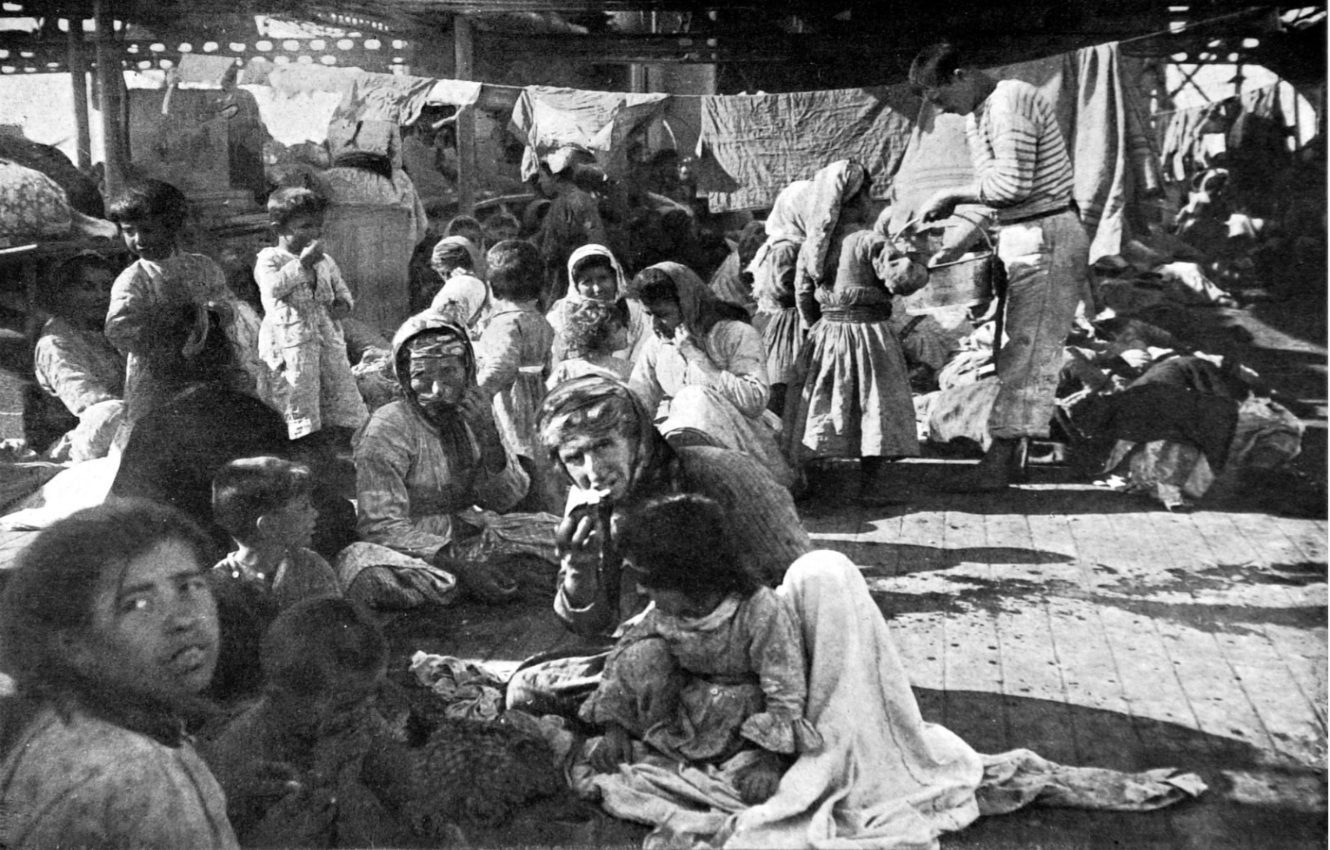
    The 50 adults and children standing here tonight – next to all the belongings they will take with them contained in two bags per person, each weighing a maximum of 23 kilos – have waited for months, some for years for this day. It is 5 AM. They’ve been here since 2 AM after a six hour bus ride from various satellite cities throughout Turkey. Yet, they show no sign of exhaustion, only the palpable excitement of children the night before Christmas.

    Sweden has taken in the most Iraqi refugees – 40,000 – while the United States, which had only taken 1,608 by the end of 2007, has implemented a program for receiving up to 15,000 Iraqi refugees by the end of 2008. Around 500,000 people have fled Bush’s new Iraq and its violence, mass abductions and economic meltdown and most of them have been Chaldean Christians.

    Arim standing with his family of five says to me, “I did not want to leave Iraq. My life is there, my work as an English teacher. My home. My friends. But lately they are making it impossible for us to stay. When my daughter entered university to become a teacher like me, she was told to convert or she would be kidnapped and raped. It was then that we knew we had to go.”

    “Wouldn’t it be easier to simply convert to Islam?” I ask.

    “We would never do that. Our fathers, our grandfathers, their fathers, for 2000 years we have been there. We will die before turning our backs on our ancestors, our faith.”

    After hours in the checkout line shuffling through all the documents, checking passport photos with faces, police letters, sponsor letters signed, the group is ready to go.

    But wait. There’s a glitch.

    Someone notices that the photo on a security letter for one of the young men does not match the photo on his identity card. A government employee hundreds of miles away in the Turkish capital of Ankara has accidentally transposed photos. Calls are frantically made from cell phones, but government offices are not open at this early hour. The International Office of Migration employee tells the family finally that she is sorry. They will not be able to go.

    The mother collapses to the floor raising her hands in the universal sign of prayer and begs, “Please, please, help us. We have no money.” Her sons and her husband try to console her, veiling their own disappointment behind cultural machismo. The IOM employee continues trying to call offices that are not yet open. She cannot find a solution.

    After at least an hour of pleading and crying and desperate attempts to talk the IOM officer into letting them go, the family concedes that their worst fears have come true. The other passengers look on with a mixture of pity and relief as the family exits the airport slowly, the father and son holding up the mother by her elbows, daughters trailing behind, heads hung low.

    “Where will they go?” I ask the IOM personel. “I don’t know, ” she says her face a blank mask, and turns back to processing the remaining 44 refugees.

    They are checked through, documents combed repeatedly at checkpoint after checkpoint, and then the only remaining gateway is passport control where once approved, the refugees will be granted entry to the other side – the side of the airport full of glittering duty free shops and restaurants, a sort of paradise before getting on a plane to heaven. Even I, without an airplane ticket, am relegated to watching from outside the pearly gates.

    One by one each passes through the barrier after saying goodbye to family and friends on the other side that wave them on. Only one elderly woman remains, melded to a young adult man, her tear racked face glued to his, bodies entwined as if to imprint a memory.

    I’d been looking away all morning gulping down rising emotions and silently repeating the mantra: be professional Robin, be professional. But it’s useless now. The tears spill in a torrent and I gulp down sobs that rise up in my throat. I watch this mother saying goodbye for the last time to a son she will likely never see again.

    My son is in America.

    They pull apart as her name is called over the loudspeaker, and the aging mother goes through the gate that separates her old life from the new, turning to gaze one last time into the eyes of her son. At that moment she scans the crowd behind the barrier and her eyes lock onto mine. Unbelievably, she comes back to where I stand and reaches over the barrier to wrap her arms around me. We stand there, a woman whose name I do not know, whose language I do not speak, holding each other. And in this moment she knows me and I know her.

    And then she is gone along with the others to America.

    Today is Thanksgiving, and I will eat turkey in Turkey with American friends. I will celebrate Thanksgiving as never before, grateful that I am free to be here, precisely because I am an American. And I will never, ever complain about filing my taxes again.

  • History of Istanbul

    History of Istanbul

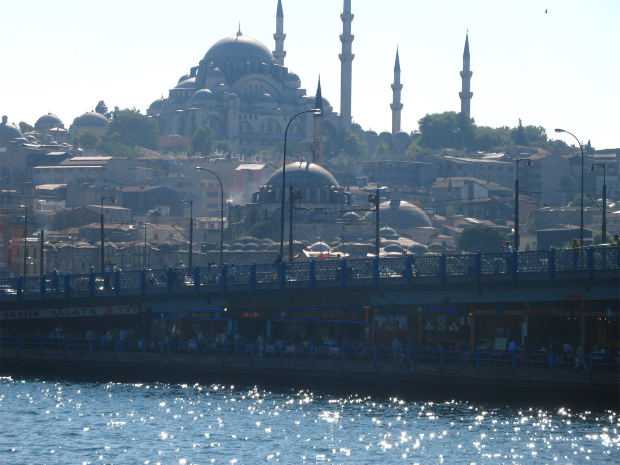
    What is now called Asian Istanbul was probably inhabited by people as early as 3000 BC. Eventually, in the 7th century, Greek colonists led by King Byzas established the colony of Byzantium, the Greek name for a city on the Bosphorus. Byzas chose the spot after consulting an oracle of Delphi who told him to settle across from the “land of the blind ones.” Indeed, Byzas concluded, earlier settlers must have been deprived of their sight to have overlooked this superb location at the mouth of the Bosphorus strait. This proved an auspicious decision by Byzas, as history has shown Istanbul’s location important far beyond what these early Greek settlers might possibly have conceived. Byzas gave his name to the city: Byzantium.

    In the early 100’s BC, it became part of the Roman Empire and in 306 AD, Emperor Constantine the Great made Byzantium capital of the entire Roman Empire. From that point on, the city was known as Constantinople. The mid 400’s AD was a time of enormous upheaval in the empire. Barbarians conquered the western Roman Empire while the Eastern, also called the Byzantine Empire, kept Constantinople as its capital. In 532 during the reign of Justinian I, antigovernment riots destroyed the city. It was rebuilt, and outstanding structures such as Hagia Sophia stand as monuments to the heights Byzantine culture reached.

    Read more : 


  • ‘Secret’ provisions in U.S.-Iraqi pact

    ‘Secret’ provisions in U.S.-Iraqi pact

    BAGHDAD, Nov. 28 (UPI) — The Iranian Press TV, citing Iraqi media outlets, said it has uncovered several secret provisions in the U.S.-Iraqi security agreement.

    The Iraqi Parliament passed a measure Thursday that outlines the framework for the withdrawal of U.S. forces from the country by 2012.

    Among the claims, Press TV says the Iraqi Interior and Defense ministries, as well as intelligence operations, will remain under U.S. supervision for the next 10 years.

    The report also says U.S. personnel operating in the country are not subject to Iraqi laws.

    “All Americans are subject to immunity,” the Iranian report says.

    A leaked English-language version of the measure in Article 12 says Iraq has the “primary right” to prosecute those parties for “grave premeditated felonies” and other crimes.

    Press TV said the Iraqi media outlets note also that the U.S. military in Iraq will have the authority to establish prisons that will operate under their control.

  • Armenia: Army Targets Students

    Armenia: Army Targets Students

    Alarm about demographic slump leads to proposed enlistment on army-age students.

    By Sara Khojoian in Yerevan (CRS No. 470 27-Nov-08)

    The Armenian government is working on amendments to legislation which would force more students to do military service, thereby overcoming a potential shortfall in recruits.

    The defence and education ministries are drawing up the changes to three existing laws, but have not yet presented them to parliament.

    “They foresee removing the right to academic leave during military call-up and setting certain benefits for students [for the duration of their army service],” said Mary Harutiunian, government spokeswoman.

    Currently post-graduate students doing a master’s or doctorate are entitled to “academic leave” which exempts them from having to serve in the military so they can concentrate on their studies.

    While the final details of the proposed changes are not yet clear, there has already been an outcry against the overall plan.

    The government says that it needs to act now to tackle a lack of conscripts for the armed forces. Beginning from this year and over the next decade, conscripts will be young men born in the 1990s, the number of whom is constantly declining, as the year 1991, when the Soviet Union broke up and Armenia became independent, marked a fall in the birth-rate.

    According to national statistics, in 1990-92 the birth-rate (for both boys and girls) was 70,000 but it has declined sharply since then to 48,000 in 1995 and 37,000 in 2006, after which it began a modest recovery.

    These trends are considered to be a threat to the country in two official documents, the National Security Strategy and the Military Doctrine.

    However, some experts say that the answer to Armenia’s military needs is to move away from conscription altogether.

    Former deputy defence minister Artur Aghabekian – currently a deputy and head of the Armenian parliament’s committee on defence, internal affairs and national security – told IWPR, “There is really a demographic problem in our country but I personally believe that general conscription is not the solution.”

    Aghabekian said it had been a mistake to close military departments in colleges and universities, which train students in army-related subjects during their studies and which he said were an important institution for preparing youngster for careers in the armed forces.

    Aghabekian said that Armenia needed to form a professional army by giving out temporary contracts to professional soldiers.

    The military currently do have units staffed by soldiers on contracts, amongst them Armenia’s international peacekeeping battalion, but there are no plans to expand this practice.

    Another former deputy defence minister Vahan Shirkhanian also believes the army needs to move away from full reliance on conscription, particularly since emigration was becoming a big problem. “From 2001 to 2006, 27,000 school-children left Armenia and, this year, from January to August alone, 83,000 people left Armenia. People who leave the country take their sons with them,” he said.

    “So just imagine how many [potential recruits] we are losing every day, which is why our eyes are always turned to universities, to call up 18-year-olds. But that’s not how the problem gets solved.

    “This plan could cause a lot of problems for education and science and also hurt the relationship between the public and the army. All the more so when problem number one for our military security is the restoration of trust between army and the public.”

    Research shows that young men do not want to serve in the army and parents are reluctant to send their children there because they consider it corrupt.

    Surveys carried out by the anti-corruption organisation Transparency International in 2002 and 2006 reveal that attitudes towards the army had not changed in those four years. In the first poll, 46.6 per cent of those surveyed said they considered the army extremely corrupt, four years later the figure was 40.4 per cent. The corresponding numbers of people who said the army was merely corrupt were 16 and 25.1 per cent.

    A major reason for public distrust of the army is the high death-rate amongst conscripts, with frequent reports of young men dying in unexplained circumstances.

    Armenia’s human rights ombudsman Armen Harutyunian has sent an official letter to the head of the government administration Davit Sargsian, saying that Armenian law was currently in line with the Europe-wide Bologna Declaration on higher education and that the rights of students to continuous study risked being abused under the new legislation.

    The chairman of parliament’s education committee Armen Ashotian said that every effort should be made to soften the impact of the new law on students – through new benefits paid to them while they serve – but insisted it was necessary.

    “We all understand that the age of conscription is approaching the ‘demographic pit’, that starts with the years 1990-1992 ,” said Ashotian. “Men born at that time should soon be called up into the army and everyone understands that the most important task is increasing the efficiency of the army.”

    But many young people are opposed to the proposed changes.

    Twenty-six-year-old Alexander Chilingirian, who has gained a doctorate in physics, said that he would never have completed his studies if he had to serve in the army.

    “The army breaks a person,” said Chilingiran. “And it doesn’t matter if you join the army at 18 and come out at 20 or if you join at 21 and come out at 23, you don’t have the will to carry anything on. In two years in the army the brain doesn’t just switch off, it degrades.”

    Sixteen-year-old Mikael Sandrosian, a second-year geology and metallurgy student in Yerevan, takes a similar view.

    “If I go into the army that it will definitely have a bad effect on my studies,” he said. “In the first place if I join up, I will forget everything I know in two years and when I return it will be hard and I won’t have the will to carry on learning.”

    Government spokesperson Mary Harutiunian said that the draft changes were now being studied by experts, then discussed in government before being presented to parliament. She said there was no time-frame for their approval.

    She said Prime Minister Tigran Sargsian had promised wide discussion of the issue to ensure that the eventual changes had public support.

    Sara Khojoian is a correspondent with Armenianow.com in Yerevan.

  • Kurds underwent deportation and genocide by Armenians several times

    Kurds underwent deportation and genocide by Armenians several times

    Baku. Lachin Sultanova – APA. Kurds face no problems in getting national rights in Azerbaijan, member of Stockholm-based Kurdish Intellectuals Union Cheto Omari said in his interview to Etnoglobus agency while commenting on his visit to Azerbaijan.
    “I am glad to visit Azerbaijan. Unfortunately, the Kurds living in the west have completely wrong information about the developments in Azerbaijan. We thought that Azerbaijanis deported and killed Kurds during Armenia-Azerbaijan conflict. I saw quite a different view in Azerbaijan. It turned out that Kurds had undergone deportation and genocide by Armenians several times. During the Soviet period Kurds were deported from Armenia, and later when the Armenians occupied Azerbaijani territories the Kurds were deported again. Azerbaijani government and people received the Kurds, defended them and gave ethnic rights to them,” he said.

    Cheto Omari said the Kurds had all democratic rights in Azerbaijan and added that the Kurds had cultural centers and a radio program.
    “I hope Azerbaijani Kurds will achieve more progress. These two nations lived together for centuries. I assure you that none of the Kurds living here had a negative opinion of Azerbaijan. They regard the Azerbaijanis as their brothers. In Azerbaijan Kurds obtained the rights they had been deprived of in Armenia,” he said.

    Touching on the relations with Azerbaijani Diaspora in Sweden Cheto Omari said the relations were not close.
    “Azerbaijan has gained its independence recently, formation of Diaspora takes time. Unfortunately, we had information about joint struggle of Kurds with Armenians. I will speak about everything I saw in Azerbaijan to the Kurdish Diaspora. We will soon come to Azerbaijan with larger delegation,” he said.

  • Women rights activist arrested in Iran

    Women rights activist arrested in Iran

    According to the news from Tabriz, Iran, Mrs Shahnaz Gholami, journalist, member of Iranian women journalist
    Association (RAZA) and women rights activist was arrested 09.11.2008 by The Ministry of Intelligence Service.

    Mrs Gholami is headeditor of “Azar Zan” weblog and had been jailed 5 years 1990-1995 in Tabriz prison due to her political activities and later she was jailed once more for a month on june 2008 for participating in Khordad 85 movement anniversary. She also has been tortured in jail.